
Developing a Workflow with NVIDIA PhysicsNeMo for Machine Learning
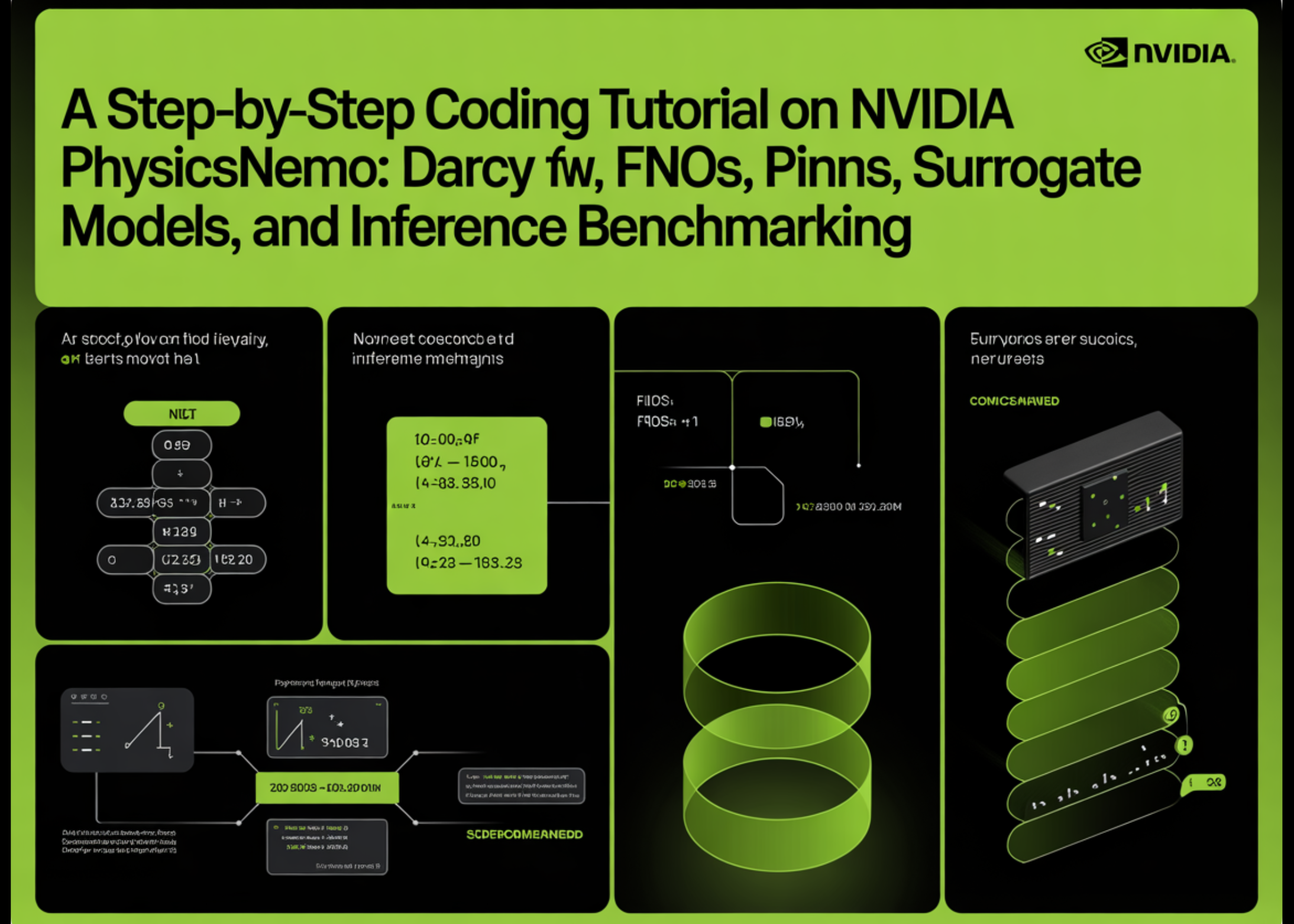
In this tutorial, we implement NVIDIA PhysicsNeMo on Colab and build a practical workflow for physics-informed machine learning. We start by setting up the environment, generating data for the 2D Darcy Flow problem, and visualizing the physical fields to clearly understand the learning task. From there, we implement and train powerful models such as the Fourier Neural Operator and a convolutional surrogate baseline, while also exploring the ideas behind Physics-Informed Neural Networks.
We compare architectures, evaluate predictions, benchmark inference, and save trained models, providing a comprehensive hands-on view of how PhysicsNeMo can be used for scientific machine learning problems. To begin, we install the necessary packages, such as nvidia-physicsnemo, matplotlib, and numpy, to ensure the smooth operation of our project.
After installing the packages, we create synthetic data for the 2D Darcy Flow problem using Gaussian Random Fields for permeability and finite differences to solve the Darcy equation. This problem serves as a classic benchmark for neural operators and is used in subsurface flow modeling, heat conduction, and other diffusion-related tasks.
During data generation, we create the DarcyFlowDataGenerator class, which will generate random permeability fields and solve the Darcy equation using the iterative Jacobi method. We also create the DarcyDataset class for working with data in PyTorch format, simplifying the subsequent model training.
Thus, this tutorial provides a complete overview of how to use NVIDIA PhysicsNeMo for solving physics-related machine learning tasks and how to effectively organize the process from installation to obtaining results.
Anthropic Launches Managed Agents, Shaping the AI Agent Market
Sqribble and Template-Driven Document Automation
Related articles

Google launches 'Skills' in Chrome for managing AI prompts
Google launches 'Skills' in Chrome for managing AI prompts.
Building a Crawl4AI Workflow for Web Crawling and Data Extraction
Learn how to set up a Crawl4AI workflow for web crawling and data extraction.
Amazon SageMaker HyperPod Optimizes Inference for AI Models
Amazon SageMaker HyperPod offers a solution for efficient AI model inference.