
How a PhD Student Created the Attention Mechanism in Neural Networks
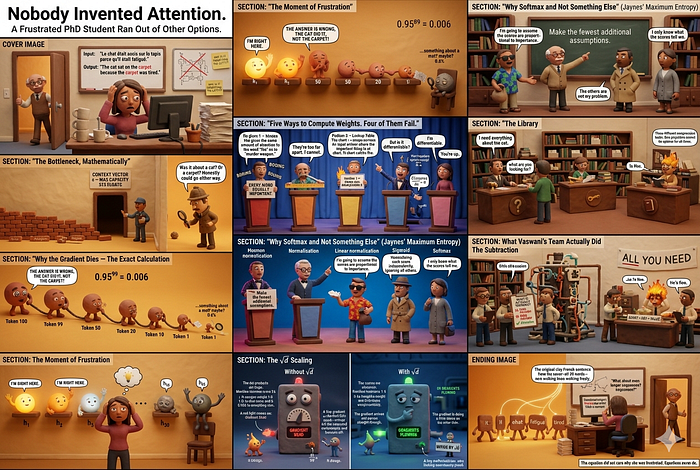
Dzmitry Bahdanau was not trying to invent the architecture that would eventually run inside every large language model on earth. During his efforts to improve long sentence translations with neural networks, he faced challenges due to the limitations of encoding long-range dependencies.
Challenges of Traditional RNN Architectures
The article discusses the mathematical constraints and issues associated with traditional recurrent neural network (RNN) architectures, ultimately leading to the development of the attention mechanism. This mechanism redefined how models handle information, allowing for better memory management in translation tasks.
Main Innovations
The main innovation arose from addressing practical questions in machine translation rather than mere theoretical constructs. This highlights the importance of a practical approach in developing new technologies.
Conclusion
Thus, Dzmitry Bahdanau's story illustrates how real-world problems can lead to significant breakthroughs in the field of artificial intelligence and machine learning.
How Leaders Can Drive Transformation with AI
Understanding MCP (Model Context Protocol) for AI Tools
Похожие статьи

Create Music with Lyria 3, Our Newest Generation Model
Discover the new music generation model Lyria 3 from Google, available for developers.

LL COOL J and James Manyika Discuss AI and Music
LL COOL J and James Manyika discuss how AI impacts music and creativity.

Launch Canvas in AI Mode for New Projects
Canvas in AI Mode is now available for everyone in the U.S., simplifying project creation.