
NVIDIA ALCHEMI Toolkit: Accelerating Simulations in Chemistry and Materials Science
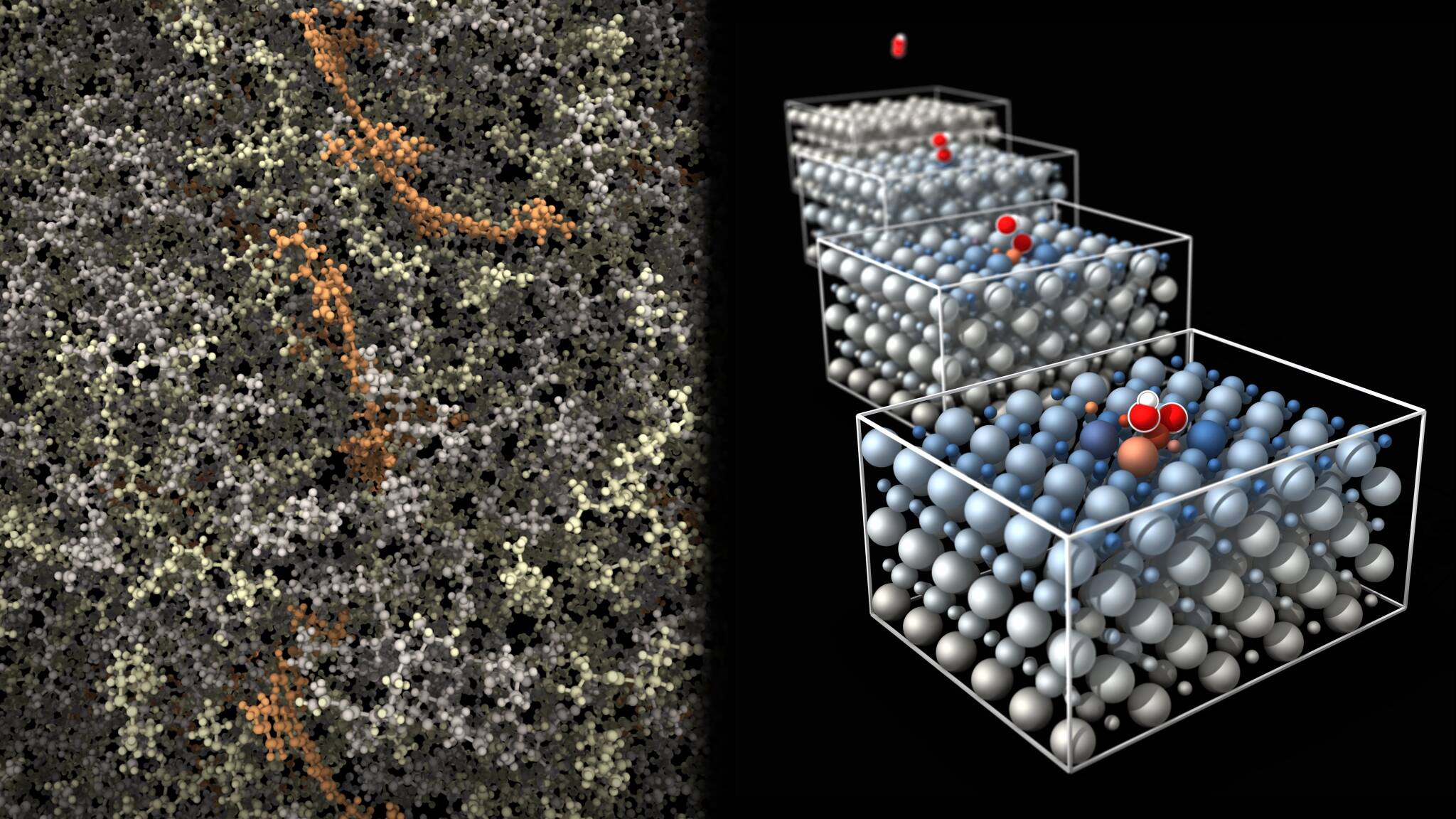
For decades, computational chemistry has faced a tug-of-war between accuracy and speed. Ab initio methods like density functional theory (DFT) provide high fidelity but are computationally expensive, limiting researchers to systems of a few hundred atoms. Conversely, classical force fields are fast but often lack the chemical accuracy required for complex bond-breaking or transition-state analysis. Machine learning interatomic potentials (MLIPs) have emerged as the bridge, offering quantum accuracy at classical speeds. However, the software ecosystem is a new bottleneck. While the MLIP models themselves run on GPUs, the surrounding simulation infrastructure often relies on legacy CPU-centric code. NVIDIA ALCHEMI (AI Lab for Chemistry and Materials Innovation) helps to address these challenges by accelerating chemicals and materials discovery with AI.
We have previously announced two components of the ALCHEMI portfolio: ALCHEMI NIM microservices, scalable, cloud-ready microservices for AI-accelerated batched atomistic simulations in chemistry and materials science, and ALCHEMI Toolkit-Ops, a set of foundational GPU kernels designed to accelerate the calculations behind simulations, such as neighbor lists, dispersion corrections, and electrostatics. Today, we are introducing the NVIDIA ALCHEMI Toolkit, a collection of GPU-accelerated simulation building blocks that incorporates and expands on ALCHEMI Toolkit-Ops. ALCHEMI Toolkit is designed to manage the data flow between accelerated chemistry and materials domain-specific kernels and deep learning models.
ALCHEMI Toolkit extends beyond individual models and kernels to provide a modular, PyTorch-native structure for researchers and developers to compose custom simulation workflows. This release includes capabilities for geometry relaxation and molecular dynamics, and the supporting pipeline infrastructure for combining multiple simulation workflows. ALCHEMI Toolkit is not just a collection of scripts; it’s designed to enable researchers and developers to build custom, performant atomistic simulation workflows with ease.
ALCHEMI Toolkit leverages the capabilities of Toolkit-Ops to handle the underlying calculations of the simulations. The previous release included several key operations: neighbor list constructions, DFT-D3 dispersion corrections, and long-range electrostatic interactions. This release broadens the scope of common operations addressed to include batched dynamics kernels and JAX support. ALCHEMI Toolkit is designed to integrate seamlessly with the broader atomistic simulation ecosystem, and we’re excited to announce the following integrations with leading platforms in the chemistry and materials science community.
Orbital develops advanced AI foundation models used to accelerate the discovery of novel cooling systems for data centers and sustainable materials. Orbital has integrated ALCHEMI Toolkit into their new OrbMolv2 model to drastically reduce the time required for inference. The new model will leverage ALCHEMI Toolkit components such as PME electrostatics for periodic Coulomb interactions. Materials Graph Library (MatGL) is an open-source framework for state-of-the-art graph-based MLIPs. ALCHEMI Toolkit is integrating with the MatGL TensorNet model to significantly accelerate materials simulations and property predictions workflows. Matlantis enables rapid materials discovery by combining universal MLIPs with high-performance cloud computing and is actively exploring the ALCHEMI Toolkit.
Google adds AI features to Chrome for saving workflows
Max Hodak prepares for first human trials of brain-computer interface
Related articles

Amazon SageMaker HyperPod Optimizes Inference for AI Models
Amazon SageMaker HyperPod offers a solution for efficient AI model inference.
Optimized Deployments in SageMaker JumpStart
Amazon SageMaker JumpStart launches optimized deployments for various tasks.
AWS Introduces Path-to-Value Framework for Generative AI Adoption
AWS has introduced the Path-to-Value framework to facilitate generative AI adoption.