
NVIDIA Advances Autonomous Networks with Agentic AI and Reasoning Models
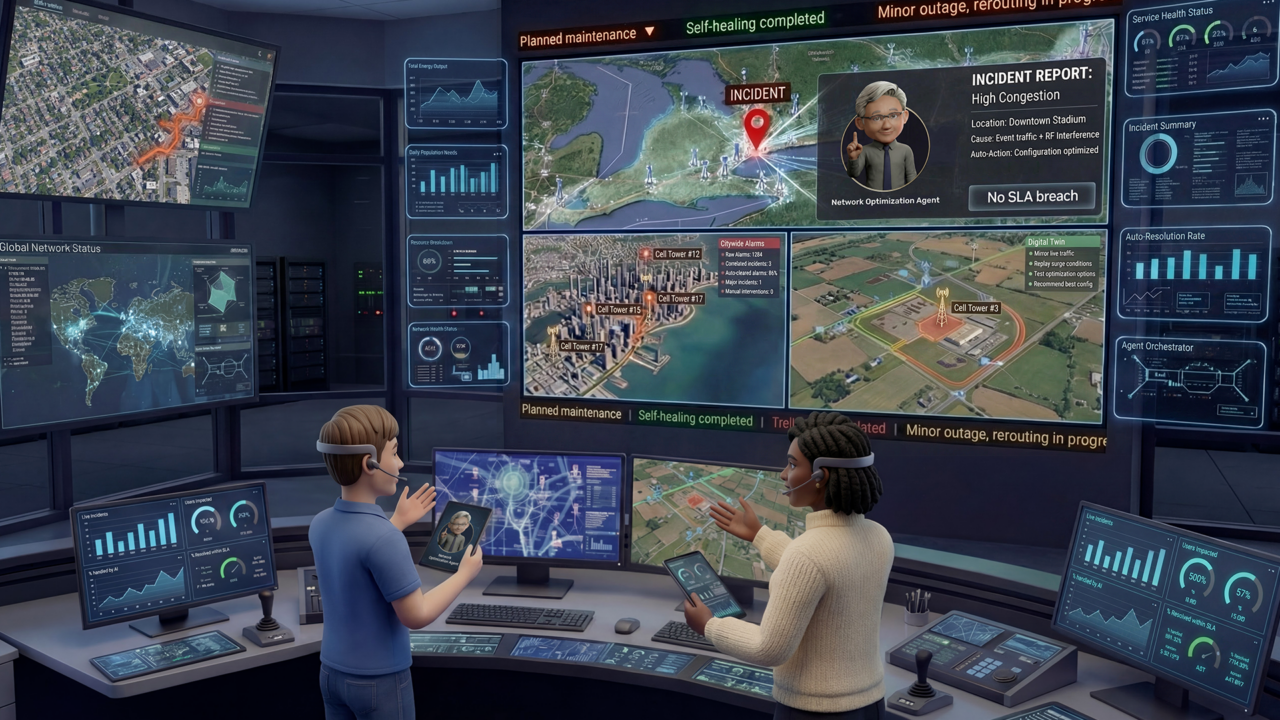
Autonomous networks, which are intelligent, self-managing telecommunications operations, are becoming a current priority for telecom operators. In the latest NVIDIA State of AI in Telecommunications report, network automation has emerged as the top AI use case for investment and return on investment. Automation differs from autonomy; beyond executing predefined workflows, autonomous networks must understand operator intent, reason through trade-offs, and decide on necessary actions. Reasoning models and AI agents fine-tuned on telecom data are crucial for enabling this transition.
For networks to become autonomous, an end-to-end agentic system is required, which includes key components such as telecom network models and AI agents that communicate with each other and utilize simulation tools to validate their actions. Ahead of the Mobile World Congress in Barcelona, NVIDIA unveiled an open large telecom model (LTM) based on NVIDIA Nemotron, serving as a comprehensive guide for developing reasoning agents for network operations, along with new NVIDIA Blueprints for energy saving and network configuration with multi-agent orchestration to assist operators in advancing toward autonomy.
To successfully operationalize generative and agentic AI across their operations, telecoms must utilize AI models capable of understanding the language of telecommunications and reasoning through complex workflows. NVIDIA has partnered with AdaptKey AI to release a new open-source 30-billion-parameter NVIDIA Nemotron LTM that operators worldwide can use to build autonomous networks. Built on the NVIDIA Nemotron 3 family of foundation models and fine-tuned using open telecom datasets, the LTM is optimized to comprehend industry terminology and reason through workflows such as fault isolation, remediation planning, and change validation.
NVIDIA and Tech Mahindra have published an open-source guide that demonstrates how telecom operators can fine-tune domain-specific reasoning models and create agents capable of safely executing network operations center (NOC) workflows. The guide outlines a framework for teaching models to reason like NOC engineers, focusing on high-impact, high-frequency incident categories, translating expert resolutions into step-by-step procedures, and creating structured reasoning traces that capture each action, tool call, outcome, and decision.
The new NVIDIA Blueprint for intent-driven RAN energy efficiency aids operators in systematically reducing power consumption in 5G networks while maintaining service quality. It integrates a platform for generating synthetic network data, enabling agents to reason based on this data and develop energy-saving policies that can be safely validated in a closed loop without altering live configurations.
The NVIDIA Blueprint for network configuration is being actively adopted by operators globally. For instance, Cassava Technologies is utilizing it to create an autonomous network optimizing Africa's diverse mobile network environment. NTT DATA is implementing the blueprint to manage traffic regulation, adapting to changing conditions in the network. These innovations help operators transition to more resilient and efficient mobile networks.
NVIDIA Launches Nemotron 3 Super with 5x Higher Throughput
Unlock Insights from Video with Amazon Bedrock Models
Related articles

Google launches 'Skills' in Chrome for managing AI prompts
Google launches 'Skills' in Chrome for managing AI prompts.
Building a Crawl4AI Workflow for Web Crawling and Data Extraction
Learn how to set up a Crawl4AI workflow for web crawling and data extraction.
Amazon SageMaker HyperPod Optimizes Inference for AI Models
Amazon SageMaker HyperPod offers a solution for efficient AI model inference.