
Optimizing Long Context LLM Inference with NVIDIA KVPress
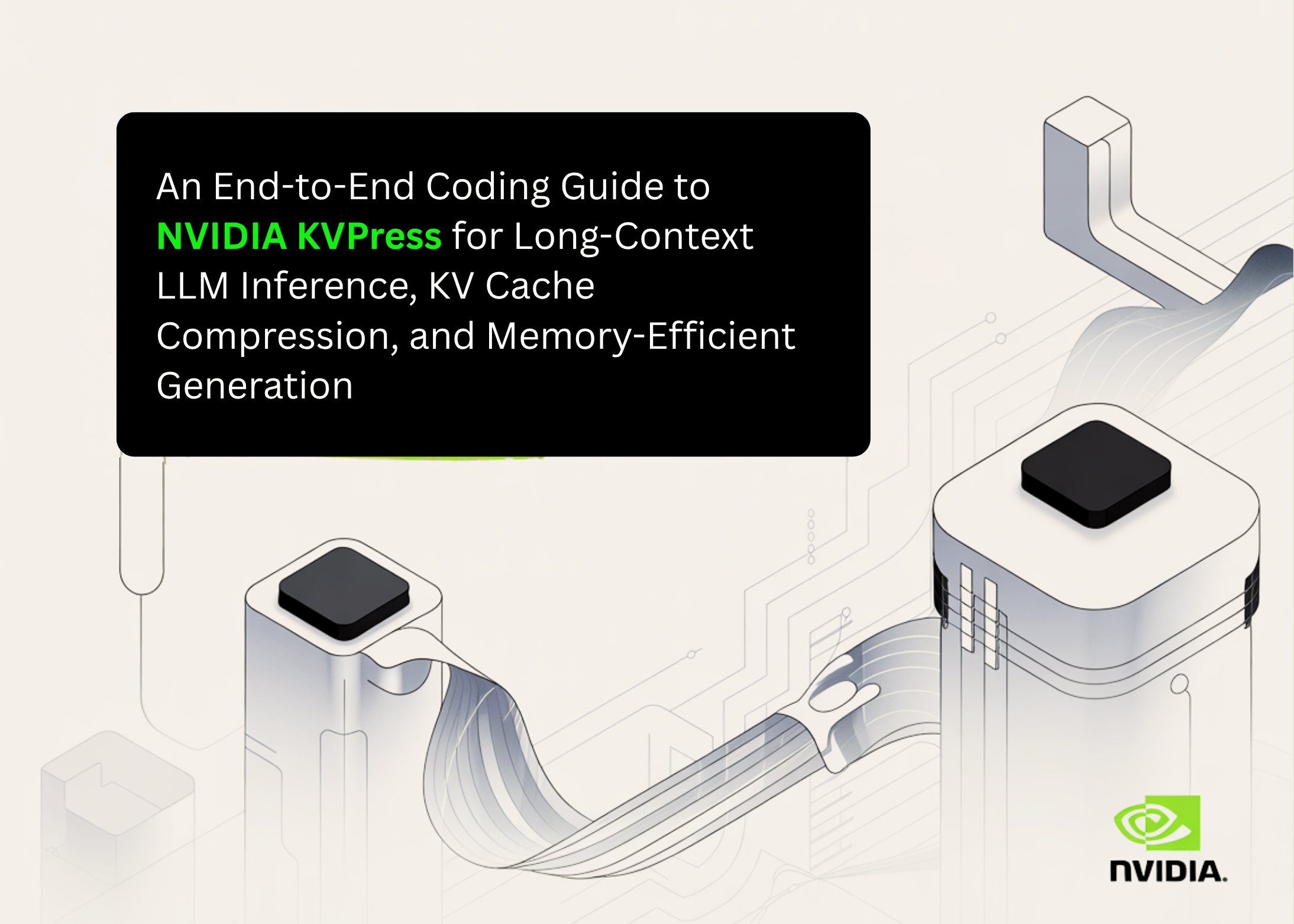
This tutorial explores how NVIDIA KVPress can enhance the efficiency of long-context language model inference. We start by setting up the full environment, installing the necessary libraries, and loading a compact Instruct model. A simple workflow will run in Colab, demonstrating the real value of KV cache compression.
As we implement, we create a synthetic long-context corpus, define targeted extraction questions, and conduct multiple inference experiments to directly compare standard generation with different KVPress strategies. By the end of the tutorial, we will have built a stronger intuition for how long-context optimization works in practice, how different press methods affect performance, and how this workflow can be adapted for real-world applications like information retrieval and document analysis.
We set up the Colab environment and install all required libraries to successfully run the KVPress workflow. We securely gather the Hugging Face token, set environment variables, and import the core modules needed for model loading, pipeline execution, and compression experiments. We also print runtime and hardware details to clearly understand the setup in which we perform the tutorial.
Next, we initialize the kv-press-text-generation pipeline and configure it based on GPU availability. We define helper functions that measure CUDA memory usage, reset peak memory, extract answers from model outputs, and run a single generation pass. This part provides the reusable execution logic that powers the rest of the tutorial and enables us to compare baseline inference with KV cache compression.
Five AI Compute Architectures Every Engineer Should Know
Meta Unveils Muse Spark: A Multimodal Reasoning Model
Related articles

Google launches 'Skills' in Chrome for managing AI prompts
Google launches 'Skills' in Chrome for managing AI prompts.
Building a Crawl4AI Workflow for Web Crawling and Data Extraction
Learn how to set up a Crawl4AI workflow for web crawling and data extraction.
Amazon SageMaker HyperPod Optimizes Inference for AI Models
Amazon SageMaker HyperPod offers a solution for efficient AI model inference.