
AI System Optimizes Robot Traffic in Warehouse
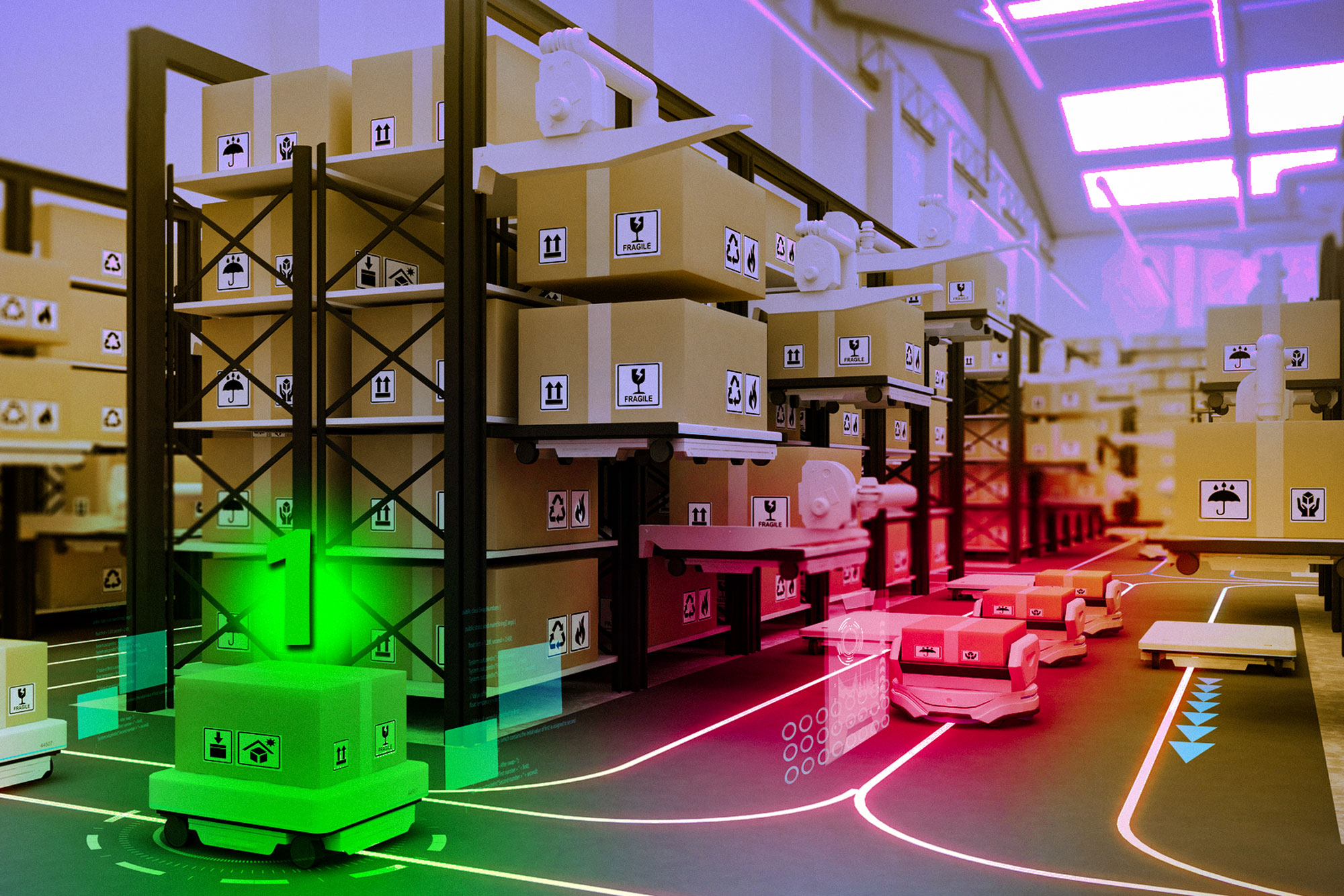
Inside a giant autonomous warehouse, hundreds of robots dart down aisles as they collect and distribute items to fulfill a steady stream of customer orders. In this busy environment, even small traffic jams or minor collisions can snowball into massive slowdowns. To avoid such inefficiencies, researchers from MIT and the tech firm Symbotic developed a new method that automatically keeps a fleet of robots moving smoothly. Their method learns which robots should go first at each moment, based on how congestion is forming, and adapts to prioritize robots that are about to get stuck. In this way, the system can reroute robots in advance to avoid bottlenecks.
The hybrid system utilizes deep reinforcement learning, a powerful artificial intelligence method for solving complex problems, to figure out which robots should be prioritized. Then, a fast and reliable planning algorithm feeds instructions to the robots, enabling them to respond rapidly in constantly changing conditions. In simulations inspired by actual e-commerce warehouse layouts, this new approach achieved about a 25 percent gain in throughput over other methods. Importantly, the system can quickly adapt to new environments with different quantities of robots or varied warehouse layouts.
“There are a lot of decision-making problems in manufacturing and logistics where companies rely on algorithms designed by human experts. But we have shown that, with the power of deep reinforcement learning, we can achieve super-human performance. This is a very promising approach, because in these giant warehouses even a 2 or 3 percent increase in throughput can have a huge impact,” says Han Zheng, a graduate student in the Laboratory for Information and Decision Systems (LIDS) at MIT and lead author of a paper on this new approach.
Coordinating hundreds of robots in an e-commerce warehouse simultaneously is no easy task. The problem is especially complicated because the warehouse is a dynamic environment, and robots continually receive new tasks after reaching their goals. They need to be rapidly redirected as they leave and enter the warehouse floor. Companies often leverage algorithms written by human experts to determine where and when robots should move to maximize the number of packages they can handle. But if there is congestion or a collision, a firm may have no choice but to shut down the entire warehouse for hours to manually sort the problem.
“In this setting, we don’t have an exact prediction of the future. We only know what the future might hold, in terms of the packages that come in or the distribution of future orders. The planning system needs to be adaptive to these changes as the warehouse operations go on,” Zheng says. The MIT researchers achieved this adaptability using machine learning. They began by designing a neural network model to take observations of the warehouse environment and decide how to prioritize the robots. They train this model using deep reinforcement learning, a trial-and-error method in which the model learns to control robots in simulations that mimic actual warehouses.
Related articles
Gemini Robotics-ER 1.6 enhances robotic perception capabilities
Gemini Robotics-ER 1.6 enhances robots' reasoning abilities about the physical world.
Autonomous underwater vehicles optimize diver operations
MIT develops autonomous underwater vehicles to assist divers in locating damages.
Hyundai expands into robotics and physical AI systems
Hyundai Motor Group invests in robotics and physical AI, changing the approach to manufacturing.