
OpenAI Unveils GPT-Rosalind: New AI for Life Sciences Research

Drug discovery is one of the most expensive and time-consuming endeavors in human history. It takes roughly 10 to 15 years to go from target discovery to regulatory approval for a new drug in the United States. Most of that time is spent not in breakthrough moments, but in painstaking analytical work — sifting through mountains of literature, designing reagents, and interpreting complex biological data. OpenAI believes AI can help compress those timelines, and today it introduced its most specialized model yet to prove it: GPT-Rosalind, the first in a new Life Sciences series.
GPT-Rosalind delivers stronger foundational reasoning in fields like biochemistry and genomics. Unlike general-purpose language models that are trained broadly across all domains, GPT-Rosalind is fine-tuned specifically for the deep analytical demands of biological research. The model is not intended to replace scientists, but rather to help them move faster through some of the most time-intensive and analytically demanding stages of the scientific process.
The model aids in understanding what “scientific reasoning” looks like in biology. For instance, a researcher working on a new gene therapy might need to survey hundreds of recent papers, identify patterns in protein structures, design a cloning protocol, and predict how a particular RNA sequence will behave in a cell. Each of these steps has traditionally required different tools, different experts, and significant time. GPT-Rosalind is positioned as a tool to assist with the complex, multi-step workflows inherent to scientific discovery.
In practice, this means the model can query specialized databases, parse recent scientific literature, interact with computational tools, and suggest new experimental pathways — all within the same interface. OpenAI is also launching a Life Sciences research plugin for Codex that connects models to over 50 scientific tools and data sources, giving researchers programmatic access to biological databases and computational pipelines through a familiar developer interface.
The model has already been evaluated in a real-world research setting, in partnership with Dyno Therapeutics, where it was tested on RNA sequence-to-function prediction using unpublished sequences. The results showed that the model significantly outperformed human experts in prediction tasks, which is a remarkable achievement for any AI system operating on novel biological data.
GPT-Rosalind is accessible within ChatGPT, Codex, and OpenAI’s API, but access is gated through a trusted-access program for qualified enterprise customers in the United States. OpenAI has implemented technical safeguards, including systems to flag potentially dangerous activity. Access is reserved for organizations working on improving human health outcomes and conducting legitimate life sciences research.
UC Berkeley and UCSF Researchers Use AI to Transform Medical Imaging
OpenProtein.AI provides biologists with protein design tools
Related articles

OpenProtein.AI provides biologists with protein design tools
OpenProtein.AI offers biologists tools for effective protein design.
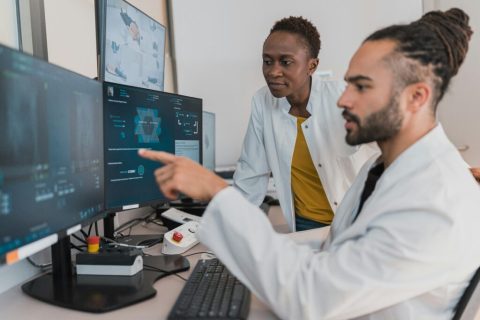
UC Berkeley and UCSF Researchers Use AI to Transform Medical Imaging
Researchers from UC Berkeley and UCSF are developing AI to improve medical imaging.

Salesforce launches Headless 360 for AI agents
Salesforce has launched Headless 360, exposing all platform capabilities for AI agents.