
Salesforce launches Headless 360 for AI agents

Salesforce has unveiled its most ambitious architectural transformation in 27 years with the launch of "Headless 360," an initiative that exposes all capabilities of its platform as APIs, MCP tools, or CLI commands, allowing AI agents to operate the entire system without ever opening a browser. The announcement was made at the company's annual TDX developer conference in San Francisco, where more than 100 new tools and skills were made immediately available to developers.
Salesforce is responding to the existential question of whether companies still need a CRM with a graphical interface in a world where AI agents can reason, plan, and execute tasks. "We made a decision two and a half years ago: to rebuild Salesforce for agents," the company stated. Instead of burying capabilities behind a UI, they are now exposed for access from anywhere.
The timing of this initiative is crucial, as Salesforce navigates one of the most turbulent periods in enterprise software history, with a sector-wide sell-off pushing the iShares Expanded Tech-Software Sector ETF down approximately 28% from its peak last September. The fear driving this decline is that AI, particularly large language models, could render traditional SaaS business models obsolete.
Jayesh Govindarjan, EVP of Salesforce, emphasized that the Headless 360 initiative is rooted in real-world lessons learned from deploying agents with thousands of enterprise customers. He pointed out that building an agentic system for each customer presents significant challenges that require innovative approaches and tools.
The Headless 360 initiative is based on three core principles. The first principle is to build any way you want, providing over 60 new MCP tools and 30 preconfigured coding skills that give external coding agents like Claude Code and Codex full access to Salesforce's data and business logic.
The second principle focuses on deploying on any surface, allowing rich interactive components to be rendered natively across various applications like Slack and Microsoft Teams without writing surface-specific code. The third principle is to build trusted agents at scale, introducing new lifecycle management tools for testing and evaluation.
Govindarjan also highlighted that many clients faced issues with AI agents due to the brittleness of the systems, leading to the development of Agent Script, a programming language designed to ensure deterministic agent behavior and simplify the process of making changes.
Physical Intelligence unveils a universal robot brain capable of learning
Startup Factory reaches $1.5B valuation to develop AI coding solutions
Related articles
OpenAI Unveils GPT-Rosalind: New AI for Life Sciences Research
OpenAI has introduced GPT-Rosalind, a new AI model to accelerate drug discovery and genomics research.

UC Berkeley and UCSF Researchers Use AI to Transform Medical Imaging
Researchers from UC Berkeley and UCSF are developing AI to improve medical imaging.
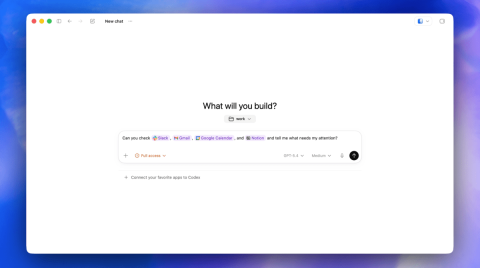
OpenAI updates Codex to compete with Anthropic
OpenAI has revamped Codex, adding new features to compete with Anthropic.