
Understanding Amazon Bedrock Model Lifecycle
Amazon Bedrock regularly releases new versions of foundation models (FM) with improved capabilities, accuracy, and safety. Understanding the model lifecycle is crucial for effective planning and management of AI applications built on Amazon Bedrock. Before migrating your applications, you can test these models through the Amazon Bedrock console or API to evaluate their performance and compatibility.
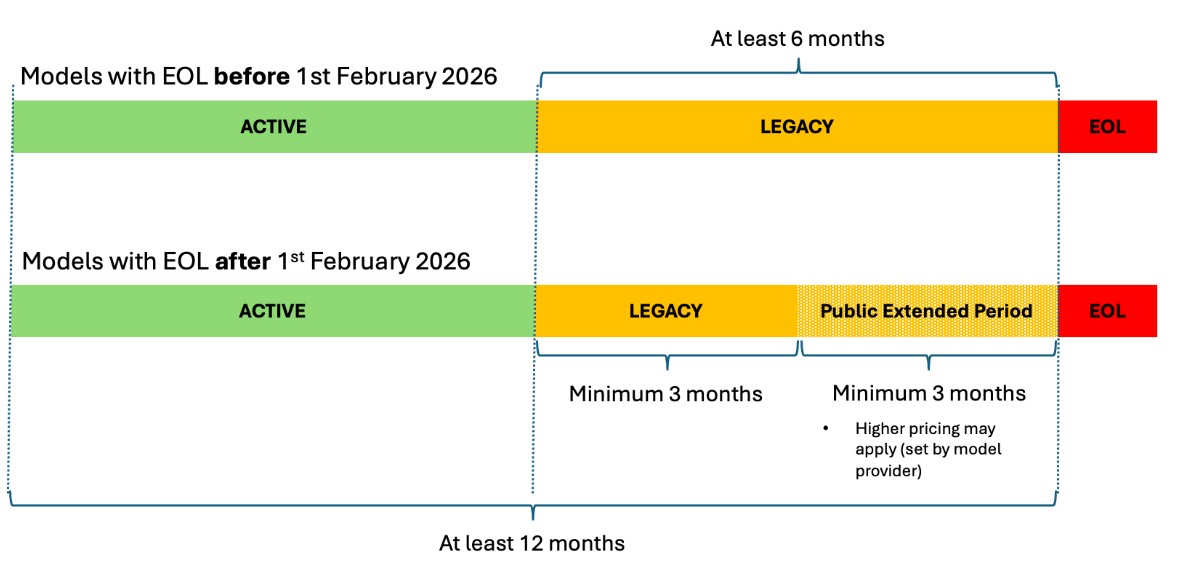
This article discusses the three lifecycle states and how to plan migrations using the new extended access feature, along with practical strategies for transitioning your applications to newer models without disruption. A model offered on Amazon Bedrock can exist in one of three states: Active, Legacy, or End-of-Life (EOL). The current status is visible in both the Amazon Bedrock console and API responses.
Active models receive ongoing maintenance, updates, and bug fixes from their providers. While a model is Active, you can use it for inference via APIs, customize it (if supported), and request quota increases through AWS Service Quotas. When a model provider transitions a model to Legacy state, Amazon Bedrock will notify customers at least 6 months in advance of the EOL date, providing essential time to plan and execute a migration to newer or alternative model versions.
During the Legacy period, existing customers can continue using the model, although new customers may be unable to access it. Organizations should note that creating new provisioned throughput by model units becomes unavailable, and model customization capabilities may face restrictions. For models with EOL dates after February 1, 2026, Amazon Bedrock introduces an additional phase within the Legacy state: Public extended access period. After spending a minimum of 3 months in Legacy status, the model enters this extended access phase.
When a model reaches its EOL date, it becomes completely inaccessible across all AWS Regions unless specifically noted in the EOL list. API requests to EOL models will fail, rendering them unavailable to most customers unless special arrangements exist between the customer and provider for continued access. Transitioning to EOL requires proactive customer action—migration does not happen automatically.
Customers will receive a notification 6 months prior to a model’s EOL date when the model provider transitions a model to Legacy state. This proactive communication approach ensures that customers have sufficient time to plan and execute their migration strategies before a model becomes EOL. Notifications include details about the model being deprecated, important dates, extended access availability, and when the model will be EOL.
Reducing Checkpoint Costs with Python and NVIDIA nvCOMP
AWS introduces Agent Registry for streamlined enterprise agent management
Related articles
Optimizing GPU Usage for Language Models and Reducing Costs
Optimizing GPU usage for language models reduces costs and increases efficiency.
Rede Mater Dei de Saúde implements AI agents for revenue optimization
Rede Mater Dei de Saúde implements AI agents for revenue optimization in healthcare.

Google launches 'Skills' in Chrome for managing AI prompts
Google launches 'Skills' in Chrome for managing AI prompts.