
Automating Hospitals with Robotics and Simulation
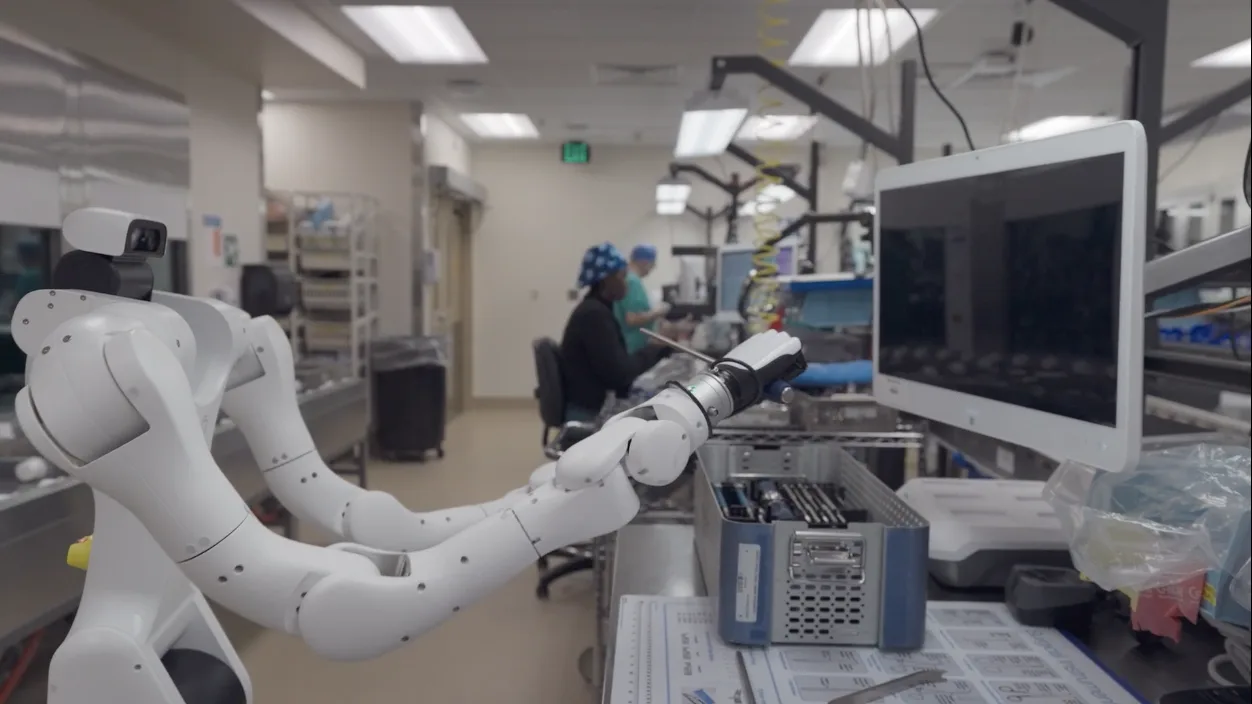
Healthcare faces a structural demand–capacity crisis: a projected global shortfall of around 10 million clinicians by 2030, billions of diagnostic exams annually with significant unmet demand, and hundreds of millions of procedures with large access gaps. The future hospital must therefore be automation-enabled, where robotics extends clinician capacity, increases procedural throughput, and democratizes access to high-quality care. Imagine autonomous imaging robots navigating patient anatomy to provide X-rays for the unserved billions, while in the OR, surgical subtask automation handles repetitive suturing so surgeons can focus on critical decisions.
The core bottleneck is data. Hospitals are heterogeneous, chaotic, and high-stakes environments—each facility has different layouts, workflows, equipment, and patient populations. Commissioning fleets of robots across diverse hospitals to capture exhaustive real-world data is economically and operationally infeasible. Even if it were possible, real-world data capturing every edge case simply doesn’t exist. Testing every scenario in live clinical settings is both unsafe and impractical.
The solution is simulation, digital twinning, and synthetic data generation. Simulation and synthetic data generation are therefore not optional—they are foundational. Virtual hospital environments allow robots to experience thousands of navigation patterns, workflow variations, and human interaction scenarios safely and at scale before deployment. High-fidelity simulation enables stress testing, long-horizon policy learning, and closed-loop training that would be impossible to achieve in the real world alone.
Project Rheo introduces a different approach. Instead of teaching robots inside hospitals, developers can now train hospitals—in simulation—before automation ever arrives. This guide walks through how developers can use the Project Rheo blueprint to build their first smart hospital digital twin and begin training Physical AI systems. Project Rheo combines physical agents and digital agents, as well as digital twin and SimReady assets, supporting complementary simulation tracks optimized for different parts of the workflow.
One of the core features of the Rheo blueprint is the rapid composition of new environments and tasks, allowing developers to quickly define clinical scenarios by combining existing assets, a robot embodiment, and a task definition. This opens new horizons for automation in hospitals and significantly enhances the efficiency of healthcare institutions.
Build the AI Grid with NVIDIA: Orchestrate Intelligence Everywhere
CUDA Tile Now Available for BASIC!
Related articles

Antioch startup develops simulation tools for robotics
Antioch develops simulation tools for robots to bridge the gap between simulation and reality.
Cadence expands AI and robotic partnerships with Nvidia and Google Cloud
Cadence Design Systems announced new partnerships with Nvidia and Google Cloud to enhance robotics and chip design.

Drones become smarter for large agricultural holdings
GEODASH Aerosystems develops smart drones for agriculture.