
Building Neural Quantum States for Frustrated Spin Systems
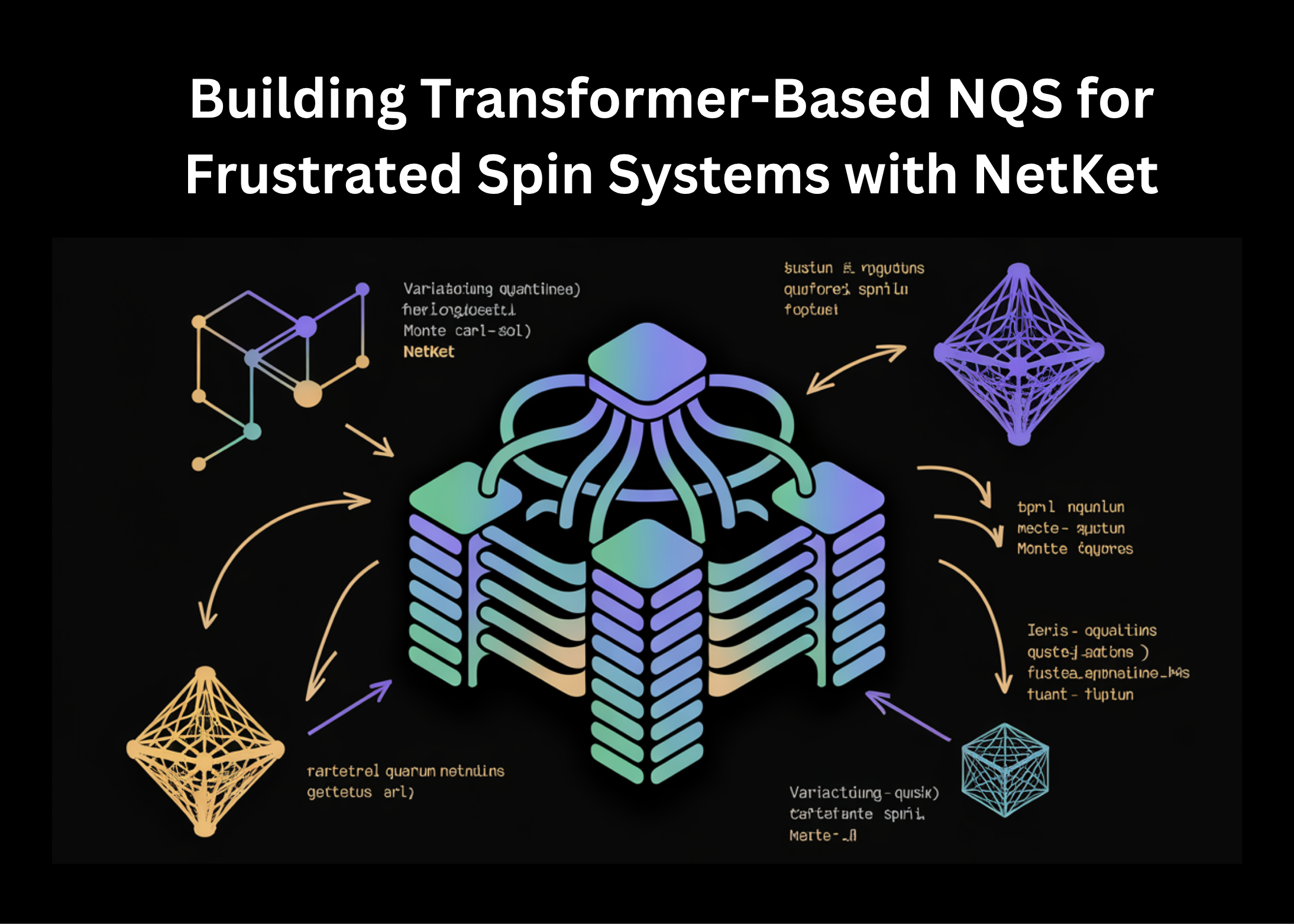
The intersection of many-body physics and deep learning has opened a new frontier: Neural Quantum States (NQS). Traditional methods struggle with high-dimensional frustrated systems, while the global attention mechanism of Transformers provides a powerful tool for capturing complex quantum correlations.
In this guide, we implement a research-grade Variational Monte Carlo (VMC) pipeline using NetKet and JAX to solve the frustrated J1–J2 Heisenberg spin chain. We will build a custom Transformer-based NQS architecture, optimize the wavefunction using Stochastic Reconfiguration, and benchmark our results against exact diagonalization.
By the end of this guide, you will have a scalable, physically grounded simulation framework capable of exploring quantum magnetism beyond the reach of classical exact methods. We install all required libraries and configure JAX for stable high-precision computation, defining the J1–J2 frustrated Heisenberg Hamiltonian using a custom colored graph representation.
We implement a Transformer-based neural quantum state using Flax. We encode spin configurations into embeddings, apply multi-layer self-attention blocks, and aggregate global information through pooling. The output is a complex log-amplitude, allowing our model to represent highly expressive many-body wavefunctions.
We sweep across multiple J2 values to explore the frustrated phase diagram. We train a separate variational state for each coupling strength and record the final energy, computing the structure factor peak for each point to detect possible ordering transitions.
Physical Intelligence unveils a universal robot brain capable of learning
Startup Factory reaches $1.5B valuation to develop AI coding solutions
Related articles

The Future of Data Compression: From Pixels to DNA
The future of data compression encompasses all types of information, from genomes to video, expanding the capabilities of digital technologies.
US-China AI performance gap closes, but responsibility gap widens
The Stanford University report indicates that while the US-China AI performance gap has closed, issues with responsibility and safety remain.
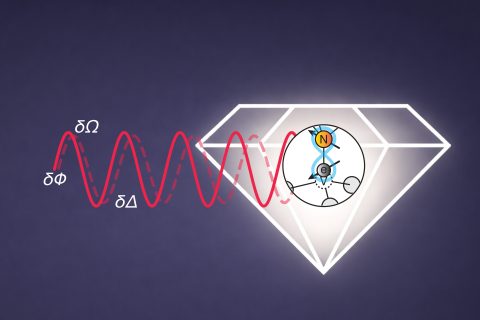
MIT develops multitasking quantum sensors for simultaneous measurements
MIT researchers have developed quantum sensors capable of measuring multiple physical quantities simultaneously.